


Where Is AI Used? Applications of Artificial Intelligence in Industries and Everyday Life
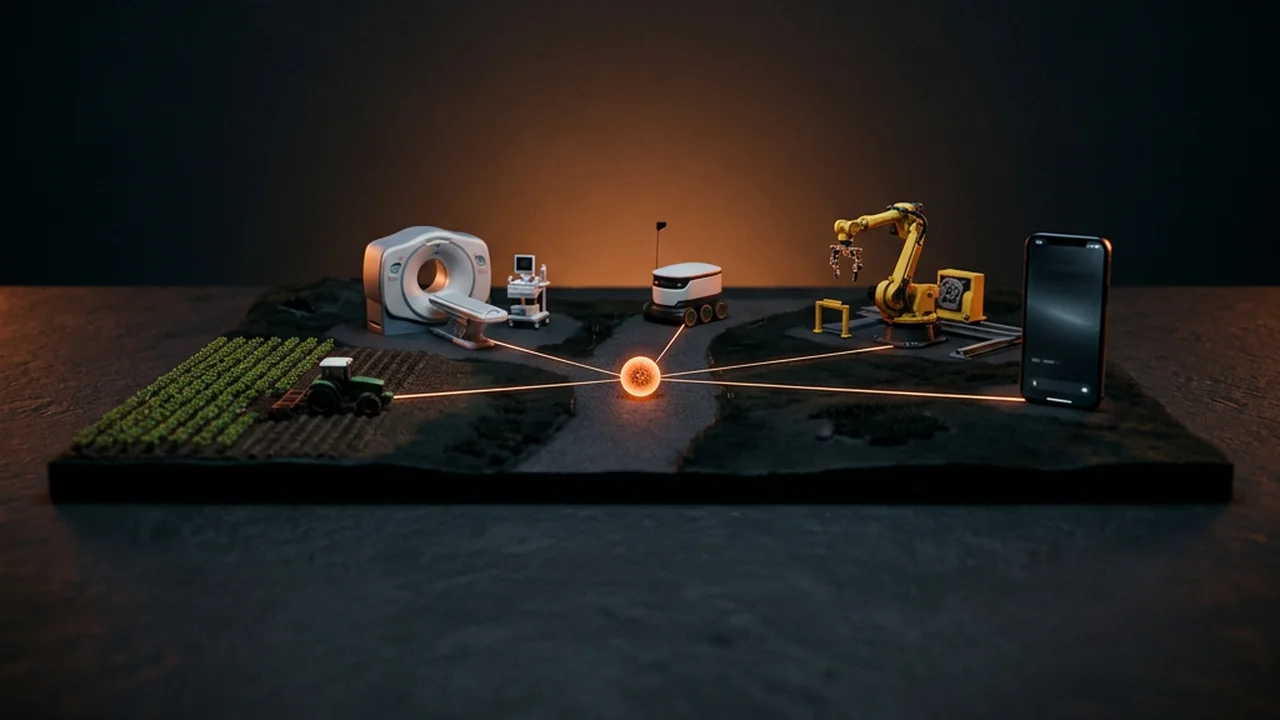
Ten years ago, artificial intelligence still looked like a technology from research labs and science fiction movies. Today it works in your phone, your banking app, your navigation app, online stores and hospitals — usually so quietly that we do not even think about it. Let's look at where AI is used today: in which industries it has already become a working tool, where we meet it in everyday life and how it helps in ordinary work, with real-world examples.
What AI can do and why it is everywhere
Artificial intelligence is a set of technologies that let a computer solve tasks that used to be possible only for humans. Modern AI systems can:
- analyze large amounts of information and find patterns in it;
- predict demand, breakdowns, risks and traffic jams;
- recognize images, faces, speech and handwriting;
- understand and write texts, translate and answer questions;
- create content — images, music, voiceovers and video;
- automate processes and support decision-making.
AI spread so widely for three reasons: there is now a lot of digital data to train it on, computing has become cheaper, and machine learning and neural networks learned to solve tasks that ordinary programs could not handle. That is why AI is built not only into specialized software, but also into everyday services, home devices and entire industries. We covered the different kinds of AI in the article "Types of Artificial Intelligence"; here we will focus on the applications of AI.
Main applications of artificial intelligence by industry
Where is AI used the most? Wherever there is a lot of data, many repetitive decisions and a high cost of mistakes or delays. Below are the key industries and the specific tasks AI solves in them.
AI in healthcare and medicine
In healthcare, AI most often works as a second pair of eyes for the doctor. Computer vision models analyze X-rays, CT and MRI scans and mammograms: they mark areas that deserve attention and help not to miss signs of disease. The final diagnosis is made by the doctor, but diagnostics become faster and the risk of mistakes caused by fatigue goes down.
Two more areas are paperwork and drug discovery. Language models transcribe recordings of appointments and help fill in medical records, and in drug development AI speeds up the search for candidate molecules. A striking example is AlphaFold, a system that predicts the 3D structure of proteins: its creators received the 2024 Nobel Prize in Chemistry for this work.
AI in finance and banking
Banking was one of the first industries where AI became mainstream. Models check every transaction in real time and flag fraudulent ones: an unusual amount, an unfamiliar location or a suspicious sequence of actions. Credit models assess a borrower's credit risk in minutes instead of days. AI also forecasts financial results, and chatbots in banking apps answer common customer questions around the clock.
AI in manufacturing
In factories, AI handles three big tasks. The first is quality control: cameras with computer vision check parts on the production line and spot defects invisible to the eye. The second is predictive maintenance: sensors on equipment send data on vibration and temperature, and the model warns about a breakdown in advance, so a machine is repaired on schedule rather than after a failure. The third is robotics: industrial robots in engineering plants and warehouses increasingly get "vision" and learn to work alongside people.
AI in transportation and logistics
In logistics, AI calculates the best delivery routes and predicts warehouse workload and arrival times. In cities, it analyzes traffic and helps control traffic lights. A separate area is autonomous transport: delivery robots already bring orders along sidewalks, and self-driving taxis and trucks are being tested and operate in some cities.
AI in education
In education, AI helps adapt learning to each student: adaptive platforms pick tasks by level and come back to topics that are harder for the student. AI helps teachers prepare learning materials, check standard assignments and come up with examples, and helps students work through difficult topics in a conversation with an AI assistant that explains things in simple words.
AI in business: marketing, retail and e-commerce
In retail and online marketplaces, AI is the foundation of personalization. Recommendation systems suggest products based on purchase and browsing history, demand forecasting models help stock the right amount of goods, and shopper behavior analysis shows at which step people abandon their cart.
The fastest-growing area here is ad creation. Neural networks write ad copy, draw banners and create videos: a seller needs only a product photo to get a promo video without a shoot or a studio.
AI in media, film and content creation
Media is the field where generative AI changed the work fastest. Neural networks help journalists transcribe interviews and draft articles, help editors pick headlines, and help video production teams make subtitles, dubbing into other languages and storyboards. Musicians use AI to find ideas and process sound, designers use it for sketches and layout options.
A new format has also appeared — video made entirely by neural networks, from the script and characters to the voiceover and music. For businesses and creators, it is a way to publish videos regularly without a film crew and long editing. Honesty matters here: generated content must not be passed off as real footage of events, and other people's likenesses and trademarks must not be used without permission.
AI in customer service
In contact centers and support teams, AI answers common questions in chat and on the phone, around the clock and without a queue, and passes complex requests to human agents together with a short summary of the problem. Speech recognition models transcribe calls, and analytics show which topics customers raise most often and where the service needs to improve. For the company, this means less load on agents; for the customer, a quick answer at any time.
AI in agriculture
In agriculture, AI analyzes satellite and drone images of fields: it shows where crops lack water or fertilizer and finds plant disease outbreaks before they become visible to an agronomist. Models forecast yields, and self-driving machinery works the field along a precise route, saving fuel and fertilizer.
AI in government and public safety
In the public sector, AI helps process citizen requests: it recognizes the topic of a letter and routes it to the right specialist. It speeds up document review, helps monitor the condition of infrastructure — roads, bridges, utility networks — and helps detect potential threats. Using AI here requires especially careful protection of personal data.
AI in everyday life: examples you meet every day
We deal with artificial intelligence every day, even if we do not notice it. Examples of AI in real life:
- Voice assistants and smart speakers recognize speech, understand the request and answer out loud — play music, set alarms, control the smart home.
- Search engines suggest a query from the first letters and understand a question asked in plain words rather than a set of keywords.
- Navigation apps predict traffic and travel time from data on millions of trips and reroute you if there is a jam ahead.
- Recommendations for movies, music and products are tailored to your taste.
- Translators and spell checkers run on natural language processing models and translate whole pages in a second.
- Your phone and its camera: face unlock, night mode, background blur in portraits, text recognition in photos.
- Email filters out spam and sorts messages into folders.
- Content generation: greeting cards, avatars, birthday messages and even your own videos made from a description.
Fun fact. Many smartphone camera features — portrait mode, night shots, photo enhancement — come not so much from the optics as from neural networks that process the frame at the moment you take the picture.
How AI is used in the workplace
Beyond industry solutions, AI has become a universal assistant for people in any profession. Where you can use AI in your daily work:
- Documents and texts. A draft of an email, a business proposal or a report, a summary of a long document, proofreading.
- Information analysis. A summary of dozens of pages, a comparison of options, patterns in spreadsheets.
- Email and requests. Sorting incoming mail, drafting replies to common questions. In contact centers, AI transcribes calls and shows what customers ask about most.
- Meetings and calls. A transcript of the recording and short minutes with decisions and action items.
- Presentations and visuals. A talk outline, images for slides, short videos.
- Programming. AI assistants write and explain code, find bugs and help you understand someone else's project.
- Planning and routine. To-do lists, repetitive operations, filling in standard forms.
Our experience at Tegas shows that AI saves the most time where several specialists used to work on one task. A promo video usually needs a scriptwriter, a camera operator, an editor and a voice actor. In Tegas, the AI assistant Tessa writes the script from a short idea, a video model shoots the scenes and a speech synthesis model voices the text — the person only has to describe the task and choose the best option. We make promo videos for apps and services this way ourselves, and AI assistants help our team with development.
Benefits and limitations of artificial intelligence
AI has clear advantages, but it is worth using with an understanding of its weak spots.
| Benefits | Limitations and risks |
|---|---|
| Processes large amounts of information quickly | Can make mistakes and confidently give wrong answers |
| Takes over routine and repetitive tasks | Result quality depends on the data the model was trained on |
| Increases specialists' productivity | Requires care with privacy: not everything should be uploaded to public services |
| Personalizes services for each person | Bears no responsibility — decisions and checks stay with a person |
| Helps analyze data and make decisions | Can reproduce biases that were in the original data |
The main rule: AI is good at drafting, finding patterns and speeding up work, but the result needs to be checked — especially in medicine, finance, legal matters and anywhere a mistake is costly.
The future of AI applications
In the coming years, AI will become even more deeply built into work. Several directions are already visible:
- AI assistants and agents. Assistants are moving from answering questions to doing tasks: find information, fill in a form, prepare a document, complete several steps in a row from one request.
- Automation of complex processes. AI takes over whole chains of tasks — for example, from a customer request to a ready business proposal.
- Robotics. Robots get smarter vision and learn to work in changing environments: in warehouses, hospitals and agriculture.
- New fields. AI is reaching small companies and industries where it used to be too expensive, because you no longer need your own development team to use it.
Some of these solutions already work, some are still in pilot projects. But the direction is clear: AI is becoming not a separate technology but a normal part of everyday work tools.
Frequently asked questions
Where is AI used the most?
Most of all in digital services used by millions of people: search, recommendations, translators, voice assistants and banking apps. Among industries, the leaders are finance, retail, marketing, healthcare and manufacturing.
Which industries use artificial intelligence?
Almost all of them: healthcare, finance, manufacturing, transportation and logistics, education, retail, agriculture and government. Only the tasks differ — in one place AI looks for defects on a production line, in another it picks products for a shopper.
Where do we see AI in everyday life?
In your phone (face unlock, photo processing), navigation apps, search engines, translators, smart speakers, recommendations on streaming services and in online stores, and the spam filter in your email.
What work tasks can AI be used for?
For preparing texts and documents, analyzing information, handling email, transcribing meetings, creating presentations, images and videos, programming and automating routine operations.
Can artificial intelligence fully replace humans?
In some routine tasks, yes, and it is already happening. But overall, AI changes work rather than eliminating it: it needs someone to set the task, check the result and take responsibility for the decision, and that remains a human job.
Is it safe to use AI services?
Yes, if you follow a few simple rules: do not upload passwords, ID and bank details, trade secrets or other people's personal data to public services; read how the service stores and uses your files; check important answers against reliable sources. For work tasks with confidential information, companies usually choose services with clear data storage terms.
Do you need to know how to code to use AI?
No. Most modern AI services work through a regular interface: you just describe the task in your own words — for example, tell the idea of a video, and the neural network will make it.
Conclusion
Artificial intelligence is already used in healthcare and finance, in manufacturing and logistics, in education, retail and agriculture — and in every smartphone. It speeds up work with information, takes over routine, helps forecast and create content. At the same time, AI remains a tool: the best results come where a person sets the task and checks the outcome. The applications of AI keep expanding — and today you can try it in your own work without any special knowledge.
Try AI video generation in Tegas
Create a video